Case studies and results from real engagements.
Get in Touch
- Phone
+91 92740 92886
- Email Now
info@codesprintconsulting.com
A-301, Sicilia Business Hub, Near ABC circle, Mota Varachha, Surat, Gujarat, India - 394101
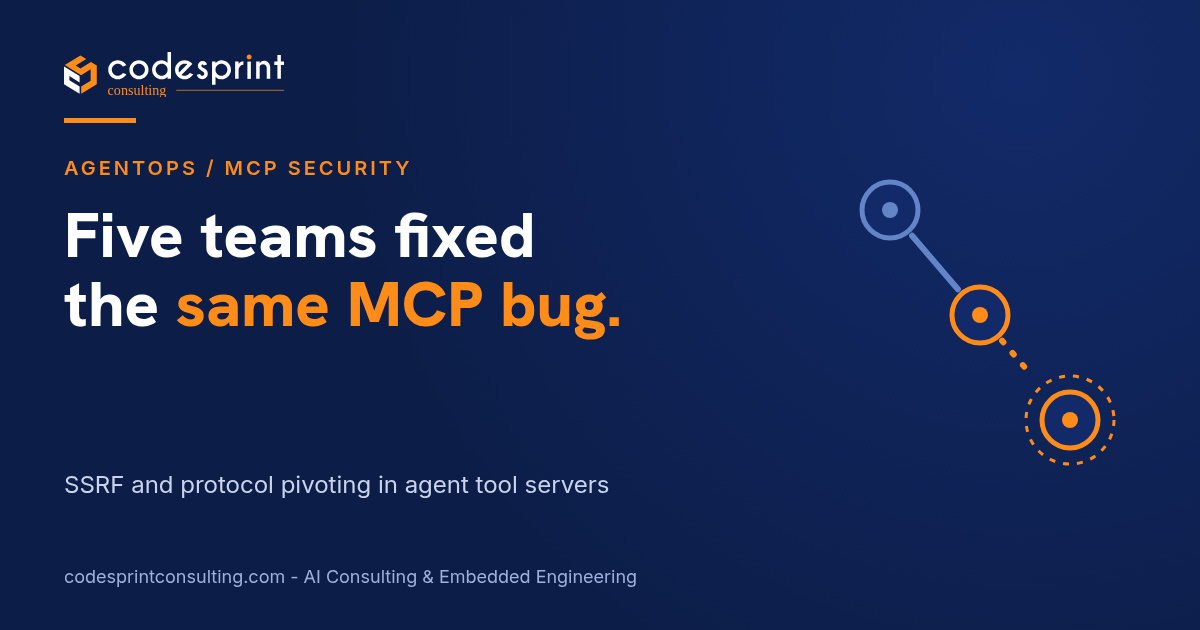

Over the past several months, security teams at Google, JPMorgan Chase, Weaviate, France's interministerial digital directorate (DINUM) and a city government in Indonesia have each fixed the same kind of bug in their Model Context Protocol (MCP) servers. One independent researcher, Syed Anas Mohiuddin, reported all five. The bug is server-side request forgery, or SSRF. Source
The organizations have little in common. They did not share code or an owner. That is the interesting part. When unrelated teams make the same mistake, the cause is usually the design pattern, not the people. Ars Technica reported the story on October 5 under the headline that the findings expose a structural flaw in MCP. Source
If your company builds or buys AI agents that call tools, this is worth a short read. Below we cover what SSRF means here, what the primary records confirm, where the reporting is thinner, and what a team can do this week.
MCP is the standard many AI agents use to call tools and data sources. An MCP server often takes a URL, a path or an endpoint from the agent and builds an outbound request from it. SSRF happens when the server does that without checking where the address really points. Whoever can steer the agent can then steer the server toward internal systems. Source
The risk is higher with agents because the "caller" is a language model, and a language model can be steered by text it reads. A web page, a document or a tool result can carry instructions. If those instructions end up inside a URL or path that a tool passes to an HTTP client, the server may fetch something nobody intended.
The best documented case is Google's MCP Toolbox for Databases. The public vulnerability record, CVE-2026-14540, says the generic HTTP source in versions 0.3.0 through 1.4.0 had an HTTP client with no restrictive redirect policy and no validation of target IP addresses. A crafted path parameter could trigger an open redirect or a direct destination swap, so the toolbox would make requests to internal or arbitrary external endpoints. Source
Google's fix is public. Pull request 3448, merged on June 18, 2026, adds an SSRF guard to the HTTP source. It protects against DNS rebinding, adds settings for allowed and blocked IP ranges and private networks, and checks the configured base URL when the server starts. The pull request credits Mohiuddin. Source
One note on severity. Scores for this CVE differ by scoring system: the Tenable listing shows 6.1 under CVSS v3 and 9.3 under CVSS v4, and press coverage quotes a rating of 8.0. We do not pick one number here. Read the record for the version that your own risk process uses. Source
The Next Web summarizes the rest, citing Mohiuddin's own write-up. We could not retrieve that write-up directly, so treat these details as secondary reporting. Source
JPMorgan: a documentation-search MCP server had two fetch tools. One checked domains against an allowlist. The other fetched any URL the caller supplied. JPMorgan's disclosure team confirmed and fixed it, and the reported severity is medium.
Weaviate: it restricted its Google module's endpoint settings to Google API hosts.
DINUM: the official MCP server for France's open-data platform fetched URLs supplied by data producers, which could point at internal or cloud metadata addresses.
Tangerang city government: a Wazuh MCP server advertised SSRF protection but only rejected literal IP addresses and never resolved hostnames.
That last case is a good lesson on its own. A check that looks at the text of a URL is not the same as a check on where the connection goes. A hostname can resolve to an internal address.
Some coverage groups a Rapid7 finding with the SSRF cases. Rapid7's own database entry describes something different. CVE-2026-97228 is a GraphQL query injection in the Rapid7 Bulk Export MCP server, in the export-status component. An unvalidated tool argument was placed directly into a GraphQL query string. The fix, in version 0.6.2, passes it as a parameterized variable instead. Source
Rapid7 rates it 2.7, which is low, and says it gives no actor access they did not already have, because injected queries run inside the operator's own authenticated scope. It names indirect prompt injection forwarding an unvalidated identifier as the realistic exposure. The family resemblance is real: an agent passes untrusted text into a tool argument, and the tool trusts it. The class of bug is different, and the severity is low. Source
Mohiuddin calls the wider attack class "protocol pivoting." As Ars Technica describes it, an attacker gains a foothold through one protocol, uses trust between protocols, and reaches capabilities that only another protocol exposes. An example is text planted in a tool result that is shaped like a task for Google's Agent-to-Agent (A2A) protocol. An orchestrating agent hands it to a subagent, which runs it because it trusts the orchestrator. Source
Not everyone agrees the term adds much. Markus Vervier of X41 D-Sec told Ars that the better name is still indirect prompt injection, and that the cross-protocol angle is not required for such attacks to work. Douglas McKee of Rapid7 gave the practical advice most teams need: treat anything passed from a language model to your tool like input from a stranger on the internet. Source
We agree with that framing. Whatever the name, the fix is old and boring: validate inputs, limit what each component may reach, and do not assume that a message from another agent is safe.
Most agent security talk centers on the model. These cases center on the glue: the tool servers, their HTTP clients, their credentials and the trust between agents. The reporting notes that MCP servers hold credentials for each agent, and that many special-purpose agents have weak guardrails, so an instruction a language model would refuse can still succeed further down the chain. Source
That makes it an operations question. Who owns each MCP server? Which network can it reach? What credentials does it hold? What gets logged? These are the questions an AgentOps practice should answer before an incident.
These steps are our recommendations, drawing on the fixes described above.
Inventory your MCP servers. List every server your agents can call, including open-source ones copied into internal repos, and the owner of each.
Update the ones with published fixes. If you run Google's MCP Toolbox, check that you are past version 1.4.0. Source
Resolve, then check. Validate the IP address a hostname resolves to at connection time, not just the text of the URL. This is the point of Google's DNS rebinding protection. Source
Restrict redirects. Set a redirect policy on every HTTP client and re-check the destination after each hop.
Block internal and metadata ranges by default. Open them only where a tool truly needs them, with an explicit allowlist.
Give each server a narrow network path. Egress rules should limit where a tool server can connect, so one mistake cannot reach your whole network.
Scope credentials per tool. A server that only reads one dataset should not hold keys for everything.
Parameterize, never concatenate. Treat each tool argument as untrusted input, as the Rapid7 fix does. Source
Log tool calls and outbound requests. You cannot investigate a pivot you did not record.
Test with hostile content. Put adversarial text in a document or web page your agent reads and see what your servers fetch.
We help teams move agents from demo to production, including the layer around the model: tool servers, permissions, network limits, credentials and logging. Our AgentOps services cover that work. If you want a second look at how your agents reach internal systems, contact us.
It is a flaw where a server builds an outbound request from an address the agent supplies without checking where that address really goes, which can expose internal systems. The Next Web
Reported fixes include Google's MCP Toolbox for Databases, a JPMorgan documentation-search server, Weaviate, a DINUM open-data server and a Wazuh MCP server run by Tangerang city. The Next Web
No. Rapid7's record describes a GraphQL query injection rated 2.7, fixed in version 0.6.2. Rapid7
It is the name Mohiuddin gives to attacks that start in one protocol and use trust between protocols to reach capabilities in another. Some researchers see it as a form of indirect prompt injection. Ars Technica
Treat every value an agent passes to a tool as untrusted, block internal address ranges by default and limit what each tool server can reach. Ars Technica
Ready to take the first step towards unlocking opportunities, realizing goals, and embracing innovation? We're here and eager to connect.